 |
 |
 |
 |
 |
 |
 |
 |
nederlands |

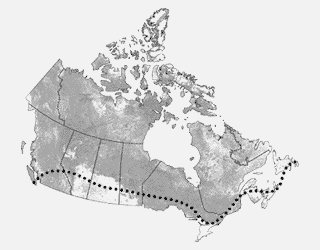
Lots of people have traveled parts of the Trans-Canada highway, but few stuck it out all the way because apart from professional travelers, few people can spare the time for such a trip.
We haven't drawn up a detailed planning for this trip. We'll be counting on fate and luck to make our journey more adventurous, so we'll just have to see what comes up.
We did plan for meetings with policy makers in Ottawa at the beginning of September. We'd like to thank the Canadian Embassy for its highly valued help setting these up.
Our mode of transport will be our own brand new VOLVO V70XC Cross Country, which is being shipped from Zeebruges to Halifax by roro, courtesy of Lacom NV & Volvo Cars, and is to be brought back from Vancouver in a container.
Any remarks, questions and suggestions visitors to www.canadadrive.be would like to share in our discussion forum will be gratefully picked up as food for thought while composing the book and the documentary.
Our main focus on this trip will be Canada's multicultural identity, as the - currently 32 million - inhabitants of this country still welcome 250.000 immigrants a year. It is common knowledge that the French and the English were the first to trade with the native inhabitants en subsequently occupied increasingly significant stretches of land. That Montreal has an important Vietnamese population, that there's an Icelandic village near Winnipeg and that there are more than 80.000 Sikhs living in Vancouver alone, are lesser known facts. There are scores of minorities of this kind in Canada, often maintaining their own language and traditions, but living in harmony with their other fellow Canadians. Of course, this society isn't without its problems. But in Canada friction between communities is negligible compared to the situation in Europe.
How this was achieved in a country where 25% of its members of parliament were born in another country is the main question we're seeking answers to on this trip.
Design by BittenBy.COM - Scripting by B. De Fraine & BitFactory